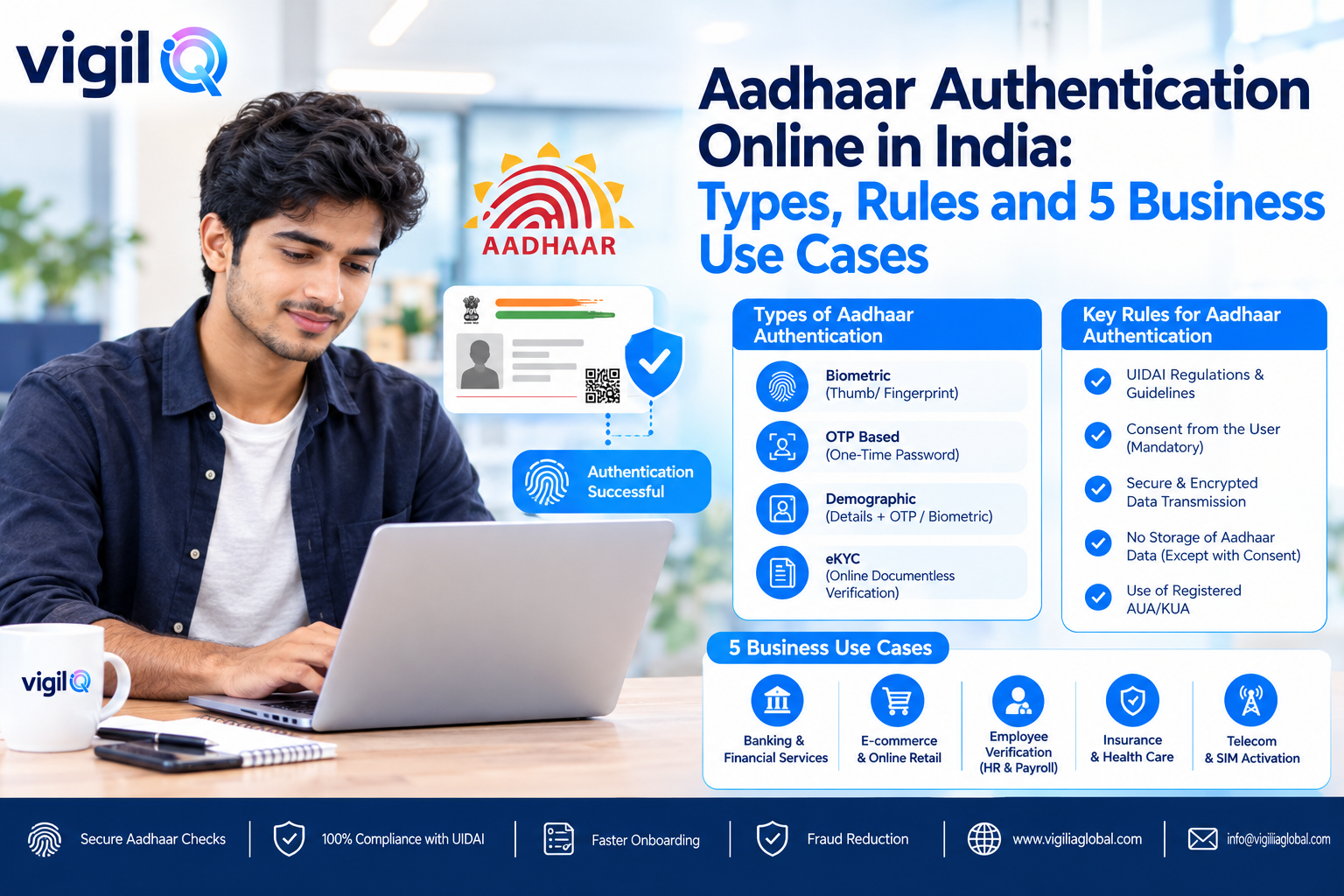
Businesses today cannot afford slow, paper-heavy identity checks. Whether you onboard a customer, hire an employee or activate a SIM card, you need proof that the person is real and present. That is why Aadhaar authentication online in India has become a core part of digital onboarding for banks, fintechs, telecoms and employers. It lets you confirm a resident’s identity against the central UIDAI database in seconds, without photocopies or field visits. This guide explains the types of authentication, the rules you must follow and five practical business use cases.
How UIDAI Aadhaar Authentication Online India Works
The Unique Identification Authority of India issues Aadhaar numbers and runs the verification network behind them. An approved business sends the Aadhaar number and one proof factor to UIDAI, and UIDAI replies with a simple match or no match response. Since UIDAI Aadhaar authentication online in India works as a yes or no service, your team never has to handle photocopies or store the full Aadhaar record.
Authentication versus e-KYC
Authentication only confirms that the submitted details match the UIDAI record. e-KYC goes one step further and returns limited verified data such as name, address and photo, but only with the resident’s explicit consent.
Who Can Use the Service
Entities licensed as Authentication User Agencies or KYC User Agencies can connect directly to UIDAI. Most small and mid-sized firms prefer to connect through a licensed partner and its API, which removes the need for heavy infrastructure and audits.
Aadhaar OTP Verification: The Fastest Way to Confirm Identity
Aadhaar OTP verification is the most widely used method because it needs no special hardware. The user enters the 12 digit Aadhaar number, UIDAI sends a one time password to the mobile number linked with it, and the user types the code to complete the check.
Best Suited For
This method works well for remote onboarding, loan applications, digital account opening and gig worker registration. It is quick, low cost and easy to add to any mobile app or web form.
Limitations to Plan For
The check fails when the mobile number is not linked to Aadhaar or the user has lost access to the SIM. Teams that rely on Aadhaar OTP verification should therefore keep a fallback route, such as an alternate approved document, so genuine customers are never blocked.
Aadhaar Demographic Authentication: Matching Name, Date of Birth and Address
Aadhaar demographic authentication compares details such as name, date of birth, gender or address with the data stored by UIDAI. It needs no device, no OTP and no biometric capture, which makes it simple to run in the background of a form.
How the Match Works
The user submits the details, the system sends them to UIDAI and a match result comes back. Even small spelling differences or format errors can cause a mismatch, so clean data entry matters.
Where It Fits Best
Because Aadhaar demographic authentication only checks data and does not prove physical presence, it works best as a supporting check alongside another factor. Many teams use it to cross verify the details a candidate or customer has already declared.
Aadhaar Biometric Authentication: Fingerprint, Iris and Face
Aadhaar biometric authentication verifies a person using a fingerprint, iris scan or face capture and matches it with the biometric data held by UIDAI. It offers the highest level of assurance because it confirms that the right person is physically present.
Device and Security Needs
Companies planning Aadhaar biometric authentication must use certified registered devices and follow UIDAI security specifications. The raw biometric data is encrypted at the point of capture and must never be stored by the business.
Typical Scenarios
Branch based onboarding, agent assisted banking, attendance systems and in-person SIM activation all benefit from this method. It is also useful in areas where mobile networks are unreliable and OTP delivery is slow.
Key Rules and Compliance Requirements
Any business planning Aadhaar authentication online in India at scale must stay inside a clear legal frame. The Aadhaar Act, 2016, the Supreme Court’s 2018 judgment and the Digital Personal Data Protection Act, 2023 together shape what is allowed. In practice, follow these rules:
- Take explicit, informed consent and state the purpose before every check.
- Use only an approved route, either a direct UIDAI licence or a licensed partner.
- Never store biometric data, and keep Aadhaar numbers in an encrypted Aadhaar Data Vault.
- Mask the first eight digits whenever the number is displayed.
- Offer an alternative ID wherever Aadhaar use is voluntary.
- Define retention limits and a grievance process in line with data protection law.
A licensed partner such as VigilIQ can handle consent capture, encryption and audit logs, so your team stays compliant without building the whole stack alone.
5 Business Use Cases of Online Aadhaar Authentication
1. Banking and Financial Services
Banks, NBFCs and fintechs use Aadhaar checks for KYC, account opening and loan disbursal. Instant identity proof cuts drop-offs and reduces fraud. To see how this fits into wider screening, read about the key components of banking background verification and what the RBI guidelines say about background verification in Indian banks.
2. Employee Background Verification
HR teams confirm that a candidate’s identity matches the documents submitted before the offer is rolled out. VigilIQ offers an Aadhaar verification API that plugs into your ATS or HRMS, so identity is checked automatically at the start of every hire.
3. E-commerce and Delivery Onboarding
Online retailers onboard riders, warehouse crews and sellers at high speed across many cities. A quick Aadhaar check confirms who they are before access to goods or cash is given. Our guide on how e-commerce background checks differ from retail checks explains the wider picture.
4. Telecom SIM Activation
Telecom operators verify subscribers at the point of sale to prevent SIM fraud and meet regulatory norms. Fingerprint and OTP based checks make activation faster and far more reliable than manual document review.
5. Insurance Policy Issuance
Insurers match applicant identity at proposal stage and again at claim settlement. This lowers the risk of fake policies and duplicate claims while shortening the customer journey.
Conclusion
Online identity checks are now a basic requirement for fast and safe onboarding. Choosing between OTP, demographic and biometric methods depends on your risk level, your channel and your users. Whatever you choose, consent, data security and approved access routes must come first. If you want to launch Aadhaar authentication online in India without building everything yourself, VigilIQ can help you go live quickly and stay compliant.
Frequently Asked Questions
1. Is Aadhaar authentication mandatory for businesses?
No, it is voluntary unless a specific law requires it, and the resident must always give consent.
2. What is the difference between authentication and e-KYC?
Authentication returns only a match result, while e-KYC returns limited verified details with the resident’s consent.
3. Can private companies use Aadhaar for verification?
Yes, when the law permits it or UIDAI approves the purpose, usually through a licensed partner and always with consent.
4. Is it safe to store Aadhaar numbers?
Store them only in an encrypted Aadhaar Data Vault, never store biometrics and always mask the digits when displayed.
5. How long does an online Aadhaar check take?
Most checks return a result within a few seconds when the resident’s details and linked mobile number are valid.