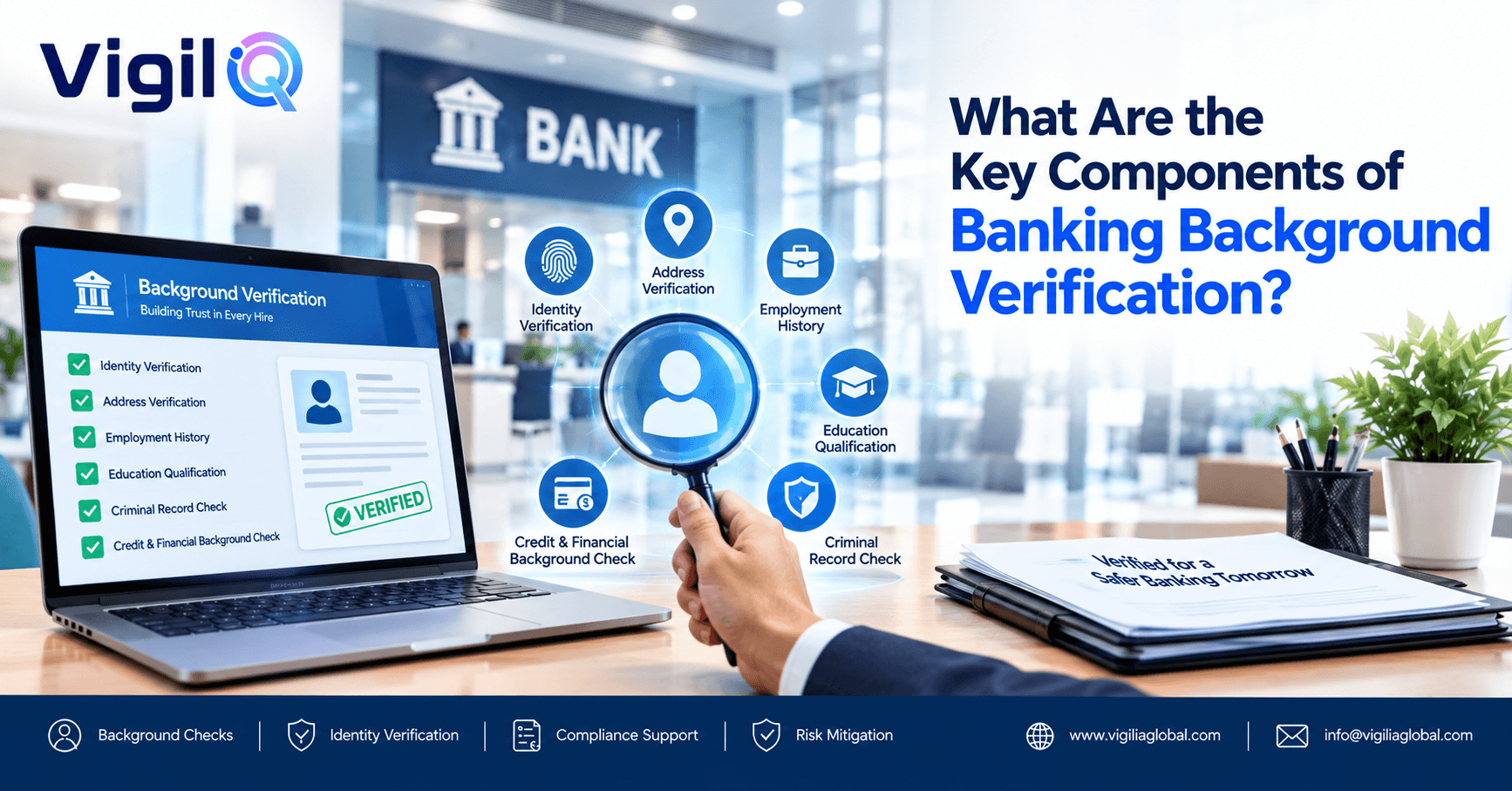
Banks handle cash, customer data, and regulated financial products every single day, which is exactly why hiring cannot stop at a resume and an interview. Understanding the banking background verification components is the first step toward building a workforce that regulators, auditors, and customers can actually trust. A single unverified credential or missed criminal record can expose a bank to fraud, compliance penalties, and reputational damage that takes years to repair. This blog breaks down every screening component that forms a complete pre-employment check for banking staff, from confirming identity to validating past employment, so HR and compliance teams know exactly what a thorough process should include.
Identity and Address Verification for Banking Staff
Every background check for a bank employee starts with confirming identity beyond doubt. Identity verification for banking staff processes typically cross-check Aadhaar, PAN, passport, driving licence, and voter ID against government databases to confirm the candidate is genuinely who they claim to be. This step also screens out synthetic identities and forged documents before a candidate ever reaches the payroll system.
Confirming Current and Permanent Address
Alongside identity, address verification also undergoes and confirms where a candidate actually lives, not just what is written on an application form. This usually combines document checks, such as utility bills or rental agreements, with physical or digital field verification for roles that involve cash handling or customer facing responsibilities. Address discrepancies are a common early warning sign in banking fraud cases, which is why this step is rarely skipped.
How Verification Fits the Broader Onboarding Timeline?
Most banks run identity and address checks early in the onboarding cycle, often before an offer letter is finalised, since these two components tend to return results the fastest. This lets HR teams flag a mismatch before a candidate is deep into notice period negotiations at their current employer, saving both sides time if something does not check out.
Criminal Record Checks in BFSI: Screening for Financial Crime Risk
A criminal record check in the BFSI sector goes well beyond a simple police clearance certificate. It typically includes court record searches across the districts a candidate has lived in, along with screening against domestic and global sanctions lists, politically exposed person databases, and adverse media coverage. Because banking staff often have access to customer funds and sensitive financial data, this component carries particular weight in the overall risk assessment.
Court and Sanctions Record Searches
Court checks confirm whether a candidate has any pending or past criminal cases, while sanctions and watchlist screening flags any association with financial crime, terrorism financing, or regulatory blacklists. Banks typically re-run parts of this check periodically, not only at the point of hiring, to catch anything that surfaces after a candidate joins.
This component is treated somewhat differently for NBFCs versus commercial banks, since the customer base and product risk profile can vary widely, but the underlying principle stays the same across the sector: no candidate should move into a role with financial access without a documented, current criminal and sanctions screen on file.
Education and Employment Verification for Finance Roles
Qualification fraud remains one of the most common issues screening teams encounter, which is why education and employment verification finance teams rely on contacting issuing universities, boards, and previous employers directly rather than accepting certificates at face value. This confirms degrees, certifications, dates of attendance, and, where relevant, the professional qualifications required for specific banking roles.
Validating Past Employment and Designation
Employment verification confirms job titles, tenure, and the reason for leaving a previous role. For banking positions, this step often extends to checking whether a candidate was terminated for misconduct, fraud, or policy violations at a prior financial institution, a detail that would not surface through a standard reference call alone.
Salary and compensation checks, where local regulations permit them, add another layer of confidence by confirming that the pay band a candidate has claimed is consistent with the role and seniority they are describing on their application.
Reference Check Bank Employees
A reference check with bank employees adds a qualitative layer that document checks cannot provide on their own. Speaking directly with former managers or colleagues helps confirm a candidate’s conduct, reliability, and suitability for roles that involve trust and discretion, such as handling customer accounts or approving transactions.
What a Good Reference Check Covers?
Beyond confirming employment dates, a thorough reference check asks about performance, integrity, teamwork, and any concerns the referee would flag if the candidate returned to a similar role. This matters most for supervisory or client-facing banking positions, where a single lapse in judgement can have outsized consequences.
What a Reference Check Cannot Replace?
A positive reference call is useful context, but it should never stand in for the document-based checks covered earlier. Former colleagues can speak to work ethic and character, yet they are rarely in a position to confirm criminal history, verify a degree certificate, or catch a fabricated employment gap. Banks that treat references as a supplement rather than a substitute end up with a far more complete picture of who they are hiring.
Why These Background Check Components Matter for Banks?
Skipping or rushing any single component weakens the entire screening process because banking risk rarely shows up in just one place. Together, these checks form the backbone of complete financial services background screening services that regulators expect financial institutions to follow. Here is what a complete process protects against:
- Confirms the candidate’s true identity before they access customer accounts or internal systems
- Verifies address details that many synthetic identity and fraud cases rely on to slip through
- Flags criminal history, sanctions exposure, and adverse media before onboarding
- Validates that academic and professional qualifications claimed for the role are genuine
- Confirms employment history and conduct at previous financial institutions
- Reduces regulatory and reputational risk under industry compliance guidelines
For most banks and NBFCs, these components are not optional extras layered onto hiring, they are the baseline expected by regulators, auditors, and increasingly, by customers who want reassurance that the people managing their money have been properly vetted. Building this into a standard, repeatable workflow rather than treating it as a one-off exercise per candidate is what separates a mature screening programme from one that only reacts after something has already gone wrong.
How VigilIQ Global Strengthens Banking Background Verification
VigilIQ Global brings each of these checks together on a single platform built for BFSI onboarding at scale. Rather than coordinating separate vendors for identity, address, criminal record, education, employment, and reference checks, banks and NBFCs can run the full banking background verification through one integrated workflow, with real-time status updates and audit-ready reporting for compliance teams.
This approach cuts turnaround time significantly compared to manual, vendor-by-vendor screening, while keeping every report structured, time-stamped, and stored for retrieval during a regulatory audit.
Banks that consolidate these checks with a single, technology-led provider generally see fewer delays and fewer gaps than those juggling several vendors for different parts of the same candidate file. Consistency in reporting format also makes it easier for compliance teams to file a clean audit trail when regulators ask for it.
Conclusion
Background verification for banking employees is not a single check; it is a coordinated set of components that together protect customers, regulators, and the institution itself. Getting these areas right, identity, address, criminal record, education, employment, and references, closes most of the gaps where banking fraud tends to originate. VigilIQ Global helps BFSI institutions run this entire process through one platform, reducing manual coordination while keeping every report audit-ready.
Frequently Asked Questions
What are the main components of a banking employee background check?
Identity verification, address verification, criminal record checks, education and employment verification, and reference checks together form the core of the process.
Why is a criminal record check important for BFSI hiring?
It flags candidates with a history of financial crime, fraud, or sanctions exposure before they gain access to customer funds and data.
How long does a full banking background check take?
Turnaround varies by check type, but automated identity and address checks often return within minutes while court and reference checks can take a few days.
Is reference checking mandatory for all banking roles?
It is not always legally mandatory, but most banks include it for supervisory, client facing, and cash handling roles as standard practice.
Can background verification for banking employees be automated?
Yes, automated platforms allow banks to run identity, address, and employment checks together while routing manual steps like reference calls separately.