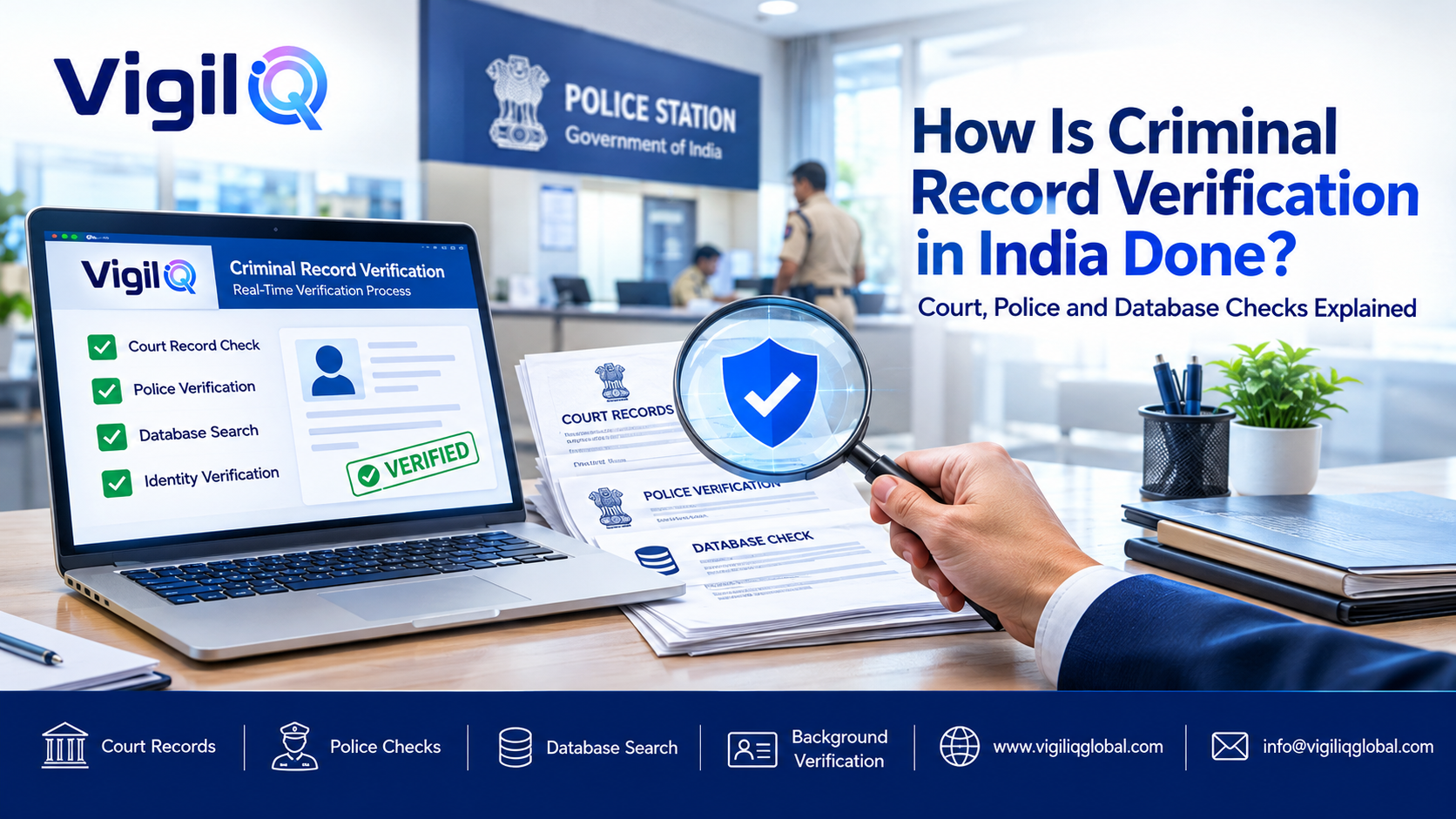
Every hiring manager shares the same worry: what if a candidate has a past that never comes up in the interview? That is where criminal record verification in India helps. It checks whether a person has pending or closed cases by searching court files, police systems and public databases. This guide explains how each layer works, what it covers and how long it usually takes, so your HR team can build a fair, consistent and defensible screening routine for every hire.
Criminal Background Check Process: Step by Step
The criminal background check process begins with the candidate and ends with a written result. Every step has a purpose, and skipping one can leave dangerous gaps in your hiring decision.
Consent and Document Collection
The employer first takes written consent from the candidate. The candidate then shares a full name, father’s name, date of birth, a government ID and address proofs. Accurate details matter a great deal, because every later search depends on them.
Search Scope and Turnaround
Next, the screening partner decides which searches to run, such as courts, police and databases. Scope should match the role. A delivery partner, a bank cashier and a senior finance head do not need identical searches, and clear scoping saves cost while avoiding unnecessary intrusion. Court and database searches often finish in a few working days, while field enquiries can take longer depending on the location.
Review and Report Delivery
Once searches are complete, analysts review every possible hit, remove namesake matches and prepare the final result. Any discrepancy is flagged so the employer can review it before making a decision.
Court Record Check in India: What Gets Searched
A court record check in India looks for civil and criminal cases filed against a person. Researchers search district courts, sessions courts, high courts and, where relevant, the Supreme Court. Many of these records are available through the eCourts services and the National Judicial Data Grid, while some older or local files still need a manual visit to the court registry.
Cases That Matter Most
Employers usually care about convictions, pending trials and cases linked to fraud, violence or financial offences. A closed case may still be relevant for sensitive roles, such as those that handle cash, customer data or vulnerable people.
Why Name Matching Is Hard
Indian names come with many spellings, initials and regional variations. A strong search therefore uses the father’s name, date of birth and address to separate the right person from namesakes. Human review of every possible hit prevents wrongful accusations and protects honest candidates from unfair rejection.
Police Verification: Local Enquiry and Certificates
Police verification confirms a person’s conduct through the police system. It is slower than a digital search, but it adds a layer of local, on-ground assurance that databases alone cannot give.
Local Police Station Enquiry
A field officer or the local police station checks whether the person lives at the stated address and whether any case is registered against them. The process depends on state rules and station workload, so timelines differ from one city to another. Partners such as VigilIQ help coordinate these enquiries, so HR teams do not need to chase stations manually.
Police Clearance Certificate
Some roles, visas and overseas jobs ask for a police clearance certificate issued by the authorities. Employers can request it from the candidate, although it is not always quick to obtain. Plan for the delay, and never hold back onboarding paperwork without telling the candidate why.
Address-Based Criminal Check: Why Location Matters
An address-based criminal check searches records linked to the places where the person has lived. Cases are usually filed in the local jurisdiction, so a search limited to one city can miss records from another. Checking both the current and permanent addresses gives a much fuller picture of a candidate’s history.
Current and Previous Addresses
Candidates who have moved often should list addresses from the last several years. Each location can add a new court or police jurisdiction to the search, which raises the chance of catching a relevant record.
Digital and Field Methods
Digital address proof is quick and low cost, while field visits confirm physical presence. Many teams combine both for senior or high-risk roles, and use the digital route alone for high-volume, lower-risk hiring.
Database Checks and What the Final Report Contains
Beyond courts and police, screening partners search structured databases. These include regulatory watchlists, fraud and sanction lists and adverse media sources. Such checks catch information that court searches may not show, especially for senior roles and financial positions.
All findings are compiled into a criminal history report that HR can store and share with auditors. VigilIQ delivers clear, audit-ready reports through a single dashboard. A good report usually includes:
- Candidate details and the identifiers used for the search
- The courts, police stations and databases searched
- Case status, such as pending, disposed or convicted
- The date of each search and the source reference
- A simple summary showing a clear result or a discrepancy
A reliable criminal history report should be easy to read, time-stamped and stored securely, so it holds up when an auditor or regulator asks for proof.
Legal Rules and Best Practices
Always take written consent, search only what is relevant to the role and treat every result as confidential. Let candidates respond to any adverse finding before you decide, because name clashes and old closed cases can mislead even careful reviewers. Regulated sectors such as banking set stricter expectations, as our guide on the key components of banking background verification explains in detail. Finally, keep reports only for as long as needed and store them with strong access controls, in line with data protection law.
Conclusion
Strong criminal record verification in India works best when court, police and database checks are combined and matched to the role. Add clear consent, careful name matching and a readable final report, and your hiring process becomes both faster and safer. If you want a trusted partner to run these checks at scale, VigilIQ can help you screen every candidate with speed, accuracy and compliance in mind.
Frequently Asked Questions
Court and database searches often take a few working days, while field enquiries can take longer.
Yes, written consent should always be taken before any search begins.
Yes, disposed cases can appear, and employers should judge them in the context of the role.
District courts, sessions courts, high courts and, where relevant, the Supreme Court are covered.
Searches should cover every listed address so that records in other jurisdictions are not missed.