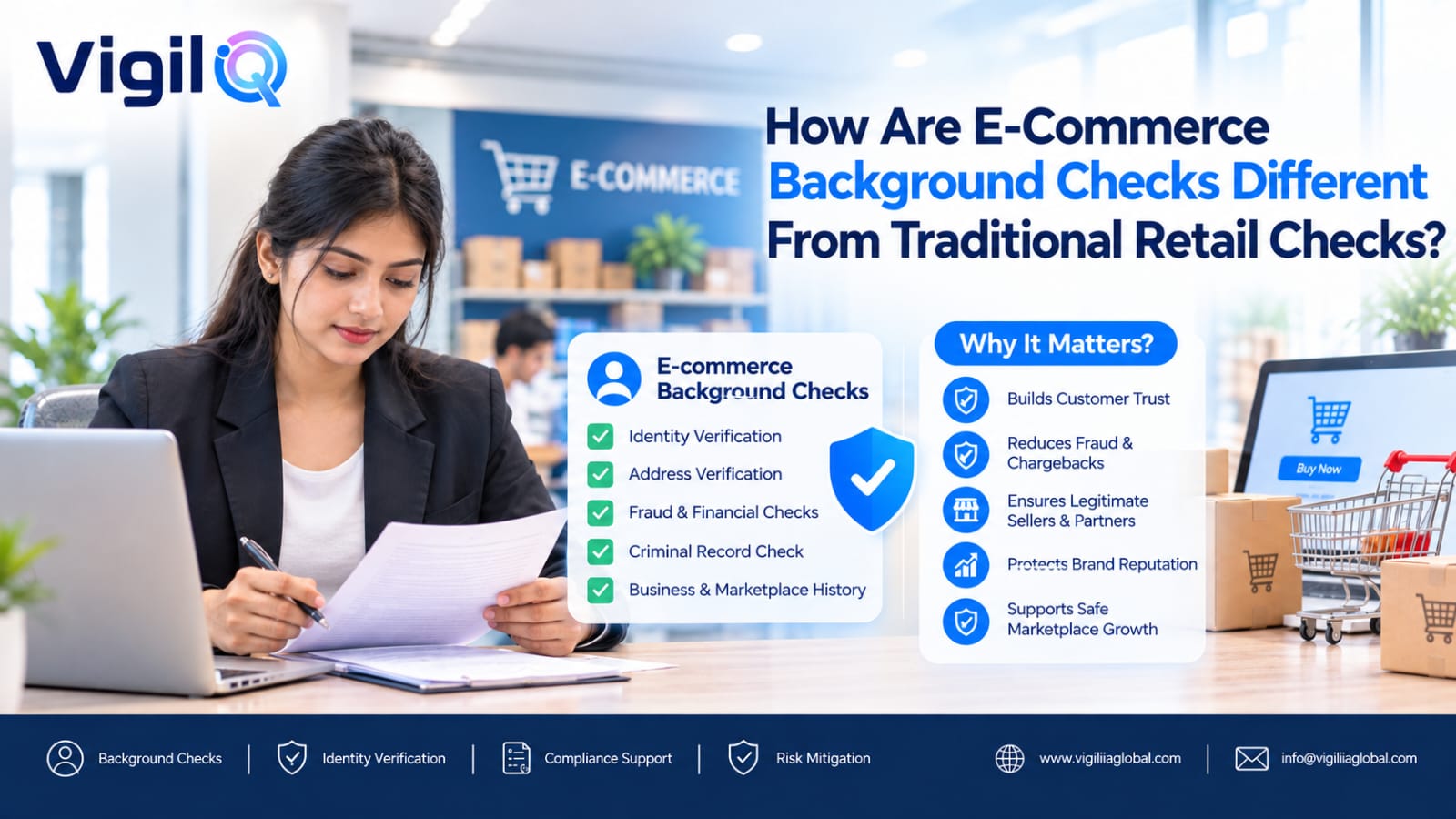
Ten years ago, hiring for a retail brand meant vetting a handful of store staff working fixed shifts under one roof. That world is mostly gone. Online retailers today hire warehouse crews, delivery riders, customer support agents, and remote fulfillment partners across multiple cities at once often all in the same week. That shift in how people are hired is exactly why e-commerce background checks now look so different from the screening process a neighborhood store used to run.
The stakes have changed too. One unverified warehouse worker or delivery partner can expose a brand to theft, data misuse, or reputational damage long before a customer ever notices something’s wrong. Understanding where e-commerce background check & screening diverges from traditional retail checks is the first step toward building a hiring process that actually fits how online retail works today and that’s what this guide walks through.
Why Store-Floor Screening Doesn’t Fit Online Retail?
The old retail hiring model
Brick-and-mortar retailers built their screening around a simple setup: employees worked one location, under direct supervision, with limited access to customer data, and a manager who could personally vouch for how they behaved on the floor. An identity check, an address verification, and a reference call from a past employer covered most of what a store manager needed to worry about. Hiring volume was predictable, turnover was moderate, and background checks were a one-time gate cleared once, rarely revisited.
What changes once hiring moves online?
Online retail breaks almost every assumption that model rested on. A single e-commerce brand might onboard hundreds of warehouse associates for a festive sale, contract dozens of delivery partners through a third-party fleet, and staff a support desk with remote agents who never set foot in an office. Hiring runs continuously instead of in seasonal batches. Roles carry different risk levels depending on what someone can access. And a large chunk of the workforce isn’t even on direct payroll. Traditional retail checks were never built for this pace or this mix of roles which is why so many online sellers end up rebuilding their screening process from scratch as they scale.
Warehouse Staff Verification: Securing Retail’s New Backbone
Why warehouses carry more risk than a storefront?
A warehouse isn’t a sales floor. It holds concentrated inventory, handles high-value returns, and gives staff access to packing areas, loading docks, and sometimes customer order details. Warehouse staff verification has to account for that concentration of risk especially during peak hiring windows, when temporary and contract workers can make up a large share of the floor. A single bad hire in a fulfillment center can cause inventory shrinkage at a scale no store counter theft ever approached, and it often goes unnoticed for weeks because no one person is watching the entire flow of goods.
What a thorough check should actually cover?
A screening process built for fulfillment centers typically includes:
- Identity verification against government-issued documents
- Criminal record checks relevant to theft, fraud, or violent offenses
- Address verification many warehouse hires come through staffing agencies with limited local vetting
- Employment history checks to catch gaps or misrepresented experience
- Reference checks with prior supervisors, where available
Because warehouse hiring often happens in bulk and on tight timelines, this sequence needs to move fast without skipping steps which is easier said than done without the right process in place.
Delivery Partner Background Check: Trust Beyond the Warehouse Door
The last-mile risk problem
Once a package leaves the warehouse, the person delivering it is the only representative of the brand a customer ever meets face to face. They know the customer’s address, their delivery schedule, and often interact with the household directly. A delivery partner background check has to weigh that kind of unsupervised, direct customer contact something a cashier behind a register never required because the platform’s reputation is on the line every time a delivery goes wrong.
Gig and contract models complicate screening
Most delivery partners aren’t full-time employees. They’re gig workers, contractors, or staff supplied by a third-party logistics partner, and they often move between platforms. That’s what makes ongoing screening not a one-time check so important: a partner who cleared a check eighteen months ago may have picked up new risk factors since. Traditional retail never had to think about recurring verification for a workforce that rotates this often and reports to no single employer. Closing that gap is now squarely on online sellers.
Online Retail Hiring Compliance: New Rules Stores Rarely Faced
Data privacy and cross-border hiring
E-commerce companies routinely handle customer payment details, home addresses, and purchase histories putting them under data protection obligations a physical store rarely dealt with. Online retail hiring compliance now means verifying that everyone with access to this data, from a support agent to a fulfillment associate, has been screened to a standard that would satisfy a regulator or an enterprise client during an audit. Many online retailers also hire across state or national lines, which pulls local labor law and documentation requirements into the picture something a single-city storefront simply never had to navigate. For companies hiring within India specifically, this is also where working with a provider offering background verification services in India, rather than piecing checks together manually across cities, tends to save the most time.
Where VigilIQ Global fits?
This is where a dedicated partner earns its place. VigilIQ Global works with e-commerce and retail businesses to build screening programs that hold up under audit covering identity, criminal, employment, and address verification through one provider instead of a patchwork of manual vendors, including background verification services in India for companies hiring locally at scale.
One Workflow for Warehouse, Delivery, and Beyond
Why a unified screening partner matters?
Running separate processes for warehouse hiring, delivery partner onboarding, and corporate staff creates gaps that fraud can slip through. A unified approach brings warehouse staff verification and delivery partner background checks under the same standards, the same turnaround times, and the same audit trail so online retail hiring compliance doesn’t depend on three vendors keeping their records in sync. It also means one point of contact when a regulator or an enterprise client asks for proof that everyone touching an order was properly checked.
E-commerce background checks at scale
This is ultimately what separates a mature screening program from a traditional retail process stretched past its limits. It has to handle continuous hiring instead of seasonal batches, screen contract and gig workers alongside direct employees, and produce records that satisfy a compliance audit rather than a store manager’s memory of who was hired last year. Companies that treat this as infrastructure not a one-time hiring step tend to catch problems before they reach a customer’s doorstep.
For related reading, see our guides on identity verification vs. background verification and types of background verification services every company should know.
Conclusion
Retail hiring used to be simple because the risk stayed inside one building, one shift. Online retail spreads that risk across warehouses, delivery fleets, remote teams, and multiple jurisdictions which is exactly why a modern e-commerce background checks program looks nothing like the one-time gate traditional stores relied on. Getting warehouse verification, delivery screening, and hiring compliance right at the same time isn’t optional for a brand operating at scale anymore, and treating them as three separate problems only slows growth down.
VigilIQ Global helps businesses build a more structured approach to workforce screening, supporting safer, more compliant hiring across the evolving e-commerce landscape.
Frequently Asked Questions
What makes online retail screening different from traditional store hiring?
It covers a wider range of roles warehouse staff, delivery partners, remote agents and runs continuously rather than as a one-time step at the point of hiring.
Do delivery partners need the same screening as full-time employees?
If anything, they often need more. Delivery partners have unsupervised, direct contact with customers and their homes, which is a different risk profile than an in-store role.
Why does warehouse hiring need a different verification process than store hiring?
It has to account for concentrated inventory access and high-volume seasonal hiring, both of which carry more risk than a single storefront register ever did.
What does compliance typically require for online hiring?
It usually means verifying that anyone with access to customer data has been screened, plus meeting local labor law requirements across every region a company hires in including region-specific needs like background verification services in India for India-based hiring.
Can one provider handle warehouse, delivery, and corporate screening together?
Yes. Running all three under one provider keeps standards consistent and makes compliance audits far easier to manage than juggling multiple vendors.