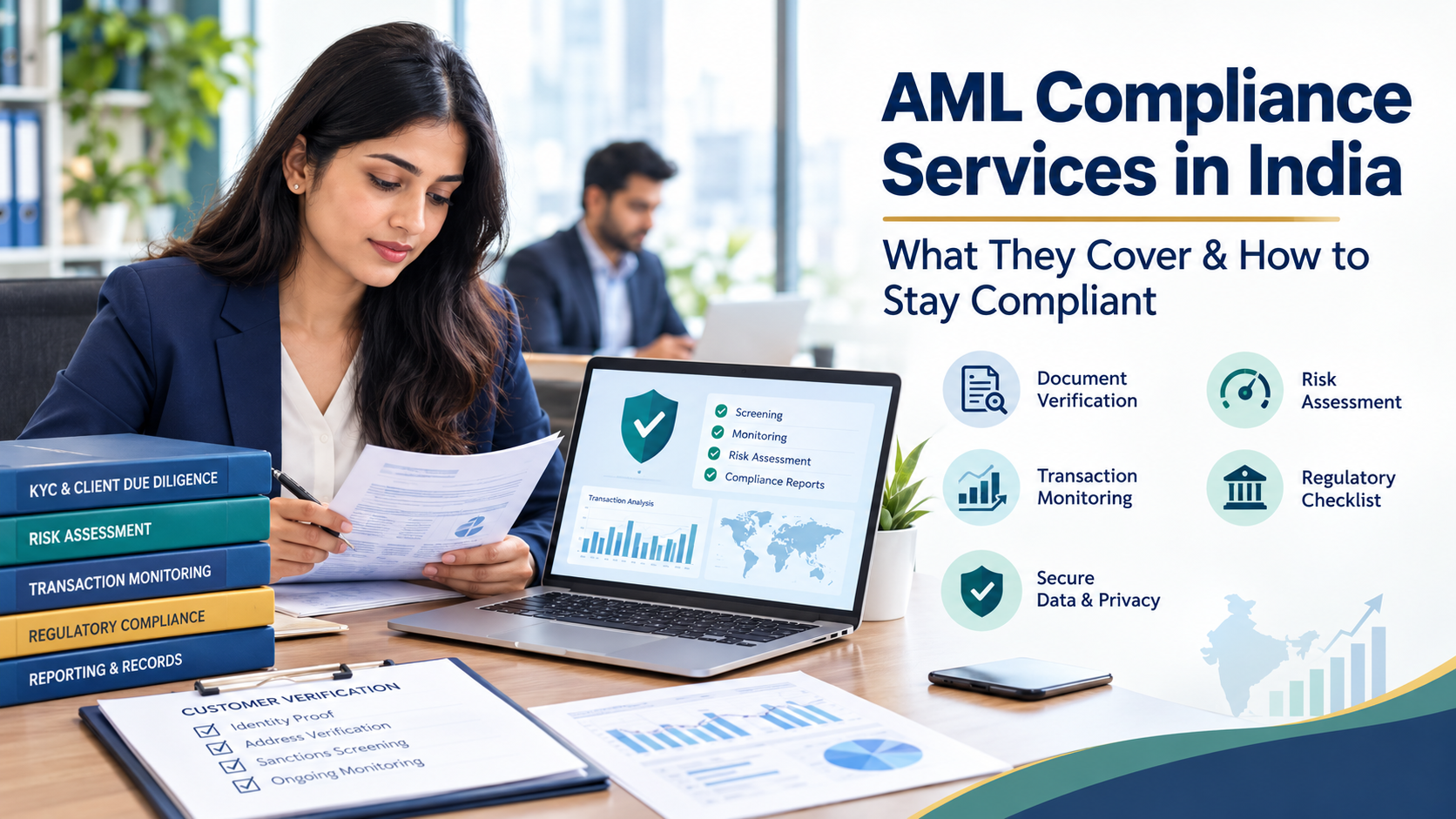
Money laundering rarely announces itself. It hides inside ordinary looking accounts, invoices and onboarding forms, and by the time a regulator asks questions, the damage to a business can already be serious. That is why AML compliance services in India matter to banks, fintechs, NBFCs, insurers, payment companies and many other regulated businesses. These services help you identify customers, screen them against watchlists, watch their activity and report anything suspicious on time. This guide explains what is covered, which rules apply and how to build a process that holds up during an audit.
Why Anti-Money Laundering India Rules Matter for Every Regulated Business
Every anti-money laundering India programme begins with a simple idea: know who you serve and watch what they do. Criminals try to move illegal funds through legitimate channels, so the law asks businesses to act as a first line of defence. Services built for this purpose usually cover onboarding checks, screening, ongoing monitoring, reporting and record keeping, which together form a complete control framework rather than a single tool.
The Law Behind the Framework
India’s core legislation is the Prevention of Money Laundering Act, 2002, usually shortened to the PMLA. It defines the offence, sets duties for reporting entities and gives the Financial Intelligence Unit of India, known as FIU-IND, the role of receiving and analysing suspicious activity reports. Sector regulators such as the Reserve Bank of India, SEBI and IRDAI add their own directions on top, so a bank, a broker and an insurer may follow slightly different detailed rules while sharing the same core duties.
Who Counts as a Reporting Entity
Banks, financial institutions, securities market intermediaries and insurers are the obvious examples. The definition has also widened over time to cover certain other businesses and professionals. If you are unsure whether you fall within scope, check your sector regulator’s latest directions or take professional advice, because the cost of guessing wrong is far higher than the cost of asking.
Why Compliance Failures Are So Costly
A weak programme exposes a business in several ways at once. Regulators can impose penalties and restrict operations, banking partners may pull back from risky clients, and a single high profile case can damage trust that took years to build. There is also a practical cost inside the company, because teams that discover gaps late must review old accounts in a rush. Investing early in clear policies and reliable tools is almost always cheaper than fixing problems under pressure from an inspection.
What KYC AML Checks Include in Practice
KYC AML checks are the front door of your compliance process. They confirm that a customer is real, establish who they are and show whether they carry unusual risk before you open an account or start a service.
Identity and Address Verification
The first layer confirms identity using official documents and databases such as PAN, Aadhaar, passport, voter ID and driving licence, along with proof of address. Digital checks return results within seconds and remove the paperwork that slows onboarding. For a closer look at the available methods, read our guide to types of identity verification. For the Aadhaar route in particular, see Aadhaar authentication online in India.
Sanctions, PEP and Adverse Media Screening
The second layer compares the customer against sanctions lists, lists of politically exposed persons and negative news. A match does not always mean rejection, but it does trigger a deeper review. VigilIQ Global offers AML and PEP screening across 170+ countries, which helps businesses with overseas customers or partners.
Checks for Business Customers
Verifying a company is different from verifying a person. You need the entity’s registration details, the identity of its directors and signatories, and a clear picture of who ultimately owns or controls it. Registry and tax identifiers help confirm that the business exists and is in good standing, while director checks reveal links to defaulters or sanctioned parties. Shell companies and layered ownership structures are a classic laundering tool, so complex structures deserve extra questions before you onboard them.
How Customer Due Diligence Works at Different Risk Levels
Customer due diligence is the structured process of collecting and verifying information, then rating the customer’s risk so that the depth of checking matches the level of danger. Regulators expect a risk based approach, which means you should not treat a salaried individual and an offshore trading company in the same way. The common levels are:
- Simplified checks for low risk customers, with basic identity proof and lighter monitoring.
- Standard checks for most customers, with full identity and address verification and a clear purpose for the relationship.
- Enhanced checks for high risk cases such as politically exposed persons, complex ownership or high risk locations, with senior approval and closer monitoring.
- Beneficial ownership checks for companies, partnerships and trusts, to identify the real people who control them.
- Periodic refresh, so records and risk ratings are reviewed as customer behaviour changes.
Document every rating decision. If an auditor asks why a customer was rated low risk, you need a written reason, not a memory.
Risk ratings should not stay frozen. Certain events should trigger a fresh review, such as a change in ownership, a new country of operation, a sudden jump in volumes or a news report linking the customer to wrongdoing. Reviewing on triggers as well as on a schedule keeps your records honest and catches problems while they are still small.
Meeting PMLA Compliance Obligations Step by Step
PMLA compliance comes down to four recurring duties: verify clients, keep records, report to the authorities and prove that your team understands the rules. Treating them as a routine rather than a one time project is what keeps you safe.
Record Keeping and Reporting
Reporting entities must maintain records of transactions and client identification for the period the law prescribes, typically five years in the key cases. They must also file reports such as suspicious transaction reports and cash transaction reports with FIU-IND within the stated timelines. Filing late, or not at all, can attract penalties and damage your standing with your sector regulator.
Appointing Officers and Training Staff
Designate a principal officer who is responsible for reporting, and appoint a designated director where your sector rules require one. Train frontline staff to recognise red flags and refresh that training at regular intervals. A policy that nobody reads will not protect you.
Working With a Screening Partner
Few teams want to build verification infrastructure from scratch. VigilIQ Global supports onboarding with API driven identity, sanctions and fraud checks, along with audit ready, securely archived reports. That combination saves time for compliance officers who would otherwise stitch together several tools and chase evidence before every inspection.
Preparing for Audits and Inspections
Inspections reward preparation. Keep a single, organised file for each customer that shows the documents collected, the checks run, the risk rating and any alerts reviewed. Test your reporting process with a mock case so that nobody is learning the steps for the first time under pressure. Record training dates and attendance, and keep versions of your policy so you can show what applied at any given time. When evidence is easy to retrieve, an audit becomes a conversation instead of a crisis. Whatever your size, the principle stays the same: be able to show what you did, when you did it and why you decided as you did.
Transaction Monitoring Basics for Growing Businesses
Transaction monitoring basics start with one simple question: does this activity make sense for this customer? Monitoring compares real behaviour with what you expected when you onboarded the person or company, and it flags the gap.
Rules and Thresholds
Set rules that raise alerts, such as unusually large cash deposits, many small transfers just below a reporting limit, sudden bursts of activity on a dormant account or payments to high risk locations. Start with a few well tuned rules instead of dozens that create noise, and review them every quarter.
Common Red Flags
Watch for customers who refuse to explain the source of funds, split transactions to avoid thresholds, route money through unrelated third parties or show a business profile that does not match their volumes. One flag is a reason to look closer. Several together are a reason to escalate.
From Alert to Report
Each alert needs a reviewer, a documented decision and a clear path to escalation. If an analyst concludes that activity is suspicious, the case moves to the principal officer, who decides whether to file a report. Keep notes factual and timely, and never tip off the customer. Good notes show regulators that your process works in practice and not only on paper.
Manual and Automated Monitoring
Spreadsheets and manual reviews can work for a very small book of customers, but they become slow and inconsistent as volumes rise. Automated systems apply the same rules to every transaction, produce time stamped alerts and keep a clean audit trail. Even then, human judgement remains essential, because software raises the flag and trained analysts decide what it means. The best setups combine both and review results regularly to reduce false alerts.
Frequently Asked Questions
What do AML services usually cover?
They cover onboarding checks, sanctions and PEP screening, risk rating, monitoring, reporting and record keeping.
Who must follow the PMLA?
Banks, financial institutions, securities intermediaries, insurers and other notified reporting entities must follow it.
How long must AML records be kept?
Records are generally kept for five years, so confirm exact rules with your sector regulator’s latest directions.
What is the difference between KYC and AML?
KYC verifies who the customer is, while AML is the wider programme that also screens, monitors and reports.
Can small businesses use automated AML tools?
Yes, API based tools let smaller teams run checks and screening without a large compliance department.
Conclusion
Strong controls protect your licence, your customers and your reputation, and they cost far less than a regulatory action. AML compliance services in India give you a practical way to verify customers, screen risk, monitor activity and report on time. Compliance is not a one time exercise, and the businesses that treat it as an ongoing habit tend to face fewer surprises. Start by mapping which rules apply to your sector, rate your customers by risk, set a small number of monitoring rules and keep clean records. If you want a partner that supports that journey from onboarding to audit, VigilIQ Global is ready to help.