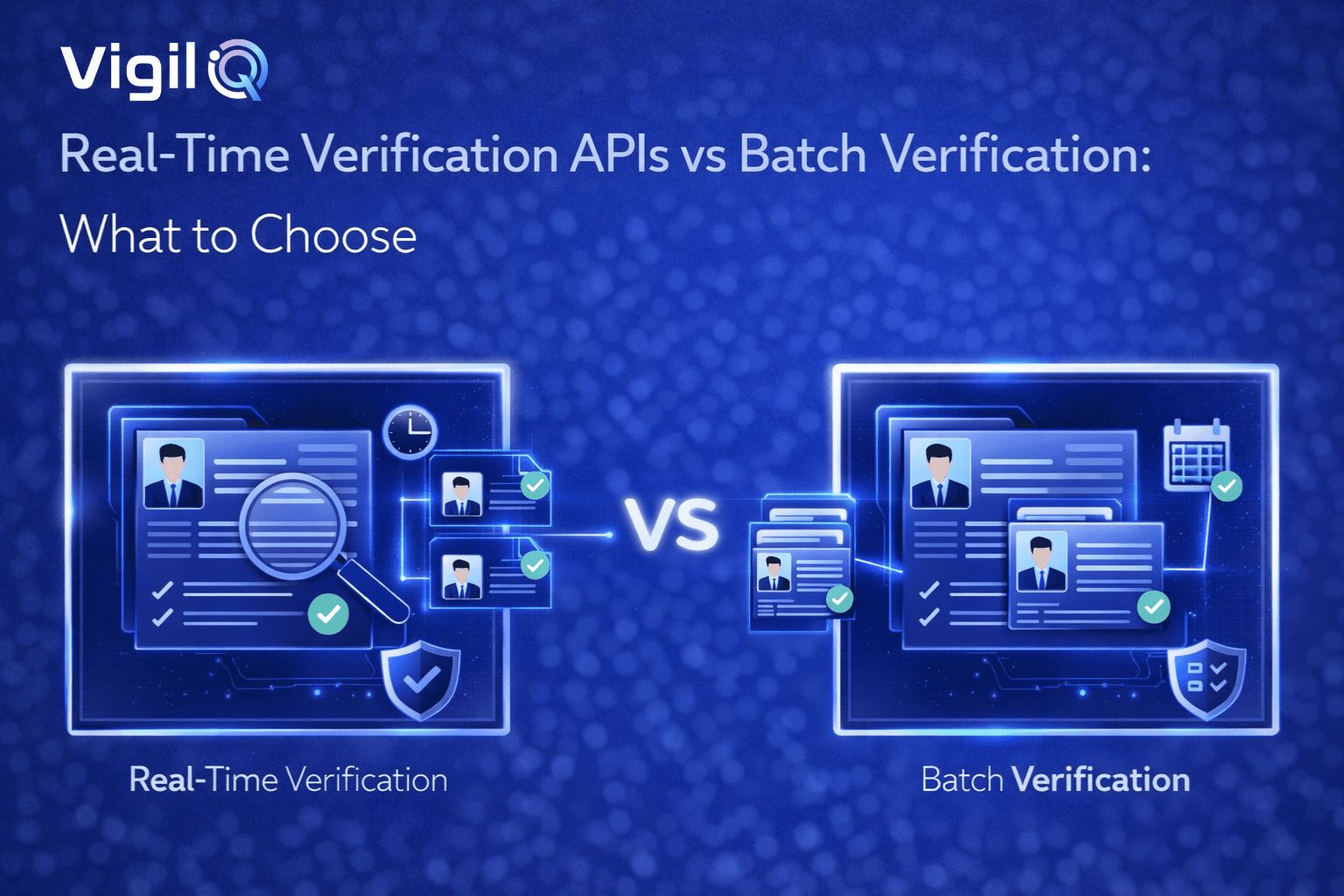
Real-Time Verification APIs vs Batch Verification: What to Choose
Real-Time Verification APIs are changing how businesses verify users, employees, and customers. Today, companies need fast and accurate verification systems to prevent fraud and improve onboarding. However, many organizations still rely on batch verification processes.
This creates a common question: Should you use real-time verification APIs or batch verification?
Both methods serve the same purpose. They help businesses verify identity, employment, and other critical data. However, they work very differently.
In this guide, we compare real-time verification APIs and batch verification. We also explain which option is better based on your business needs.
What Are Real-Time Verification APIs?
Real-Time Verification APIs allow businesses to verify data instantly. These APIs connect directly with trusted databases and return results within seconds.
For example, companies can use real-time APIs for:
- Identity Verification
- Employment Verification
- Address Verification
- PAN Card Verification
- Aadhaar Verification
Because these APIs work instantly, they are ideal for digital onboarding and fast hiring.
As a result, businesses can make quick and secure decisions.
What Is Batch Verification?
Batch verification processes multiple records at once. Instead of verifying each candidate or user individually, companies upload large datasets for verification.
These datasets are processed together. Results are usually delivered after some time, depending on the volume.
Batch verification is commonly used for:
- Bulk employee verification
- Periodic compliance checks
- Database cleansing
- Large-scale audits
Therefore, batch verification is useful for non-urgent verification tasks.
Key Differences Between Real-Time Verification APIs and Batch Verification
Understanding the differences helps businesses choose the right approach.
Speed
Real-Time Verification APIs provide instant results. Therefore, they are ideal for onboarding and hiring.
Batch verification takes more time. Results may take hours or days.
Accuracy
Real-time APIs connect with live data sources. As a result, they provide more accurate and up-to-date information.
Batch verification may rely on stored or delayed data. Therefore, accuracy may vary.
Use Case
Real-time verification is best for:
- Customer onboarding
- Instant hiring decisions
- Fraud prevention
Batch verification is better for:
- Bulk data processing
- Periodic checks
- Compliance audits
Integration
Real-time APIs can be integrated into apps and platforms. This allows seamless verification during workflows.
Batch verification often requires manual uploads and processing.
Why Businesses Prefer Real-Time Verification APIs
Many companies are shifting to real-time verification APIs. This shift is driven by the need for speed and security.
Faster Onboarding
Customers and candidates expect quick onboarding. Real-time APIs allow instant verification.
As a result, businesses improve user experience.
Better Fraud Prevention
Fraud risks are increasing. Real-time verification detects issues immediately.
For example, companies can use Identity Verification to confirm user details instantly.
Improved Hiring Efficiency
Recruiters can verify candidate information during hiring. This reduces delays and improves decision-making.
Businesses often combine real-time APIs with Employment Verification to confirm work history.
Seamless Integration
Real-time APIs integrate easily with HR systems, fintech platforms, and apps.
Therefore, verification becomes part of the workflow.
When Batch Verification Still Makes Sense
Although real-time APIs are powerful, batch verification still has its place.
Bulk Data Processing
Organizations handling large datasets may prefer batch verification.
Compliance Requirements
Some regulatory checks require periodic verification of employee data.
Cost Considerations
Batch processing may be more cost-effective for large-scale operations.
Therefore, batch verification is useful for specific use cases.
Real-Time Verification APIs for Hiring
Real-time verification APIs are especially useful in hiring.
Recruiters can verify identity, employment, and criminal records instantly. This reduces hiring risks.
For example:
- Identity Verification ensures candidate authenticity
- Employment Verification confirms work history
- Criminal Record Verification identifies legal risks
As a result, companies can make faster and safer hiring decisions.
Real-Time Verification APIs for Fintech and KYC
Fintech companies rely heavily on real-time verification APIs.
They use APIs for:
- KYC verification
- UPI verification
- Bank statement analysis
- Credit checks
Because fintech requires instant decisions, batch verification is not practical.
Real-time APIs ensure security and compliance.
Combining Real-Time and Batch Verification
Many businesses use both methods together.
Real-time APIs handle instant verification during onboarding. Batch verification handles periodic checks and audits.
This hybrid approach provides flexibility and efficiency.
Challenges of Real-Time Verification APIs
Despite their benefits, real-time APIs have some challenges.
- Integration complexity
- Dependency on external data sources
- API costs
- Data privacy requirements
However, these challenges can be managed with proper implementation.
Future of Verification: Real-Time First
The future of verification is real-time.
As digital transformation continues, businesses will rely more on instant verification systems.
Real-time verification APIs will become the standard for hiring, onboarding, and compliance.
Companies that adopt these technologies early will gain a competitive advantage.
FAQs
What are real-time verification APIs?
Real-time verification APIs are tools that validate user or candidate data instantly using live data sources.
What is batch verification?
Batch verification processes multiple records together and provides results after a delay.
Which is better: real-time or batch verification?
Real-time verification is better for instant decisions, while batch verification is useful for bulk processing.
Where are real-time verification APIs used?
They are used in hiring, fintech, KYC, and customer onboarding.
Can businesses use both methods?
Yes, many businesses combine real-time and batch verification for better efficiency.
Conclusion
Real-Time Verification APIs and batch verification both play important roles in modern verification systems.
However, real-time APIs are becoming the preferred choice for businesses that need speed, accuracy, and security.
They enable instant decision-making, reduce fraud, and improve user experience.
Batch verification remains useful for bulk processing and compliance checks.
Therefore, the best approach is to choose the right method based on your business needs.
Organizations that adopt real-time verification APIs will stay ahead in today’s fast-paced digital environment.