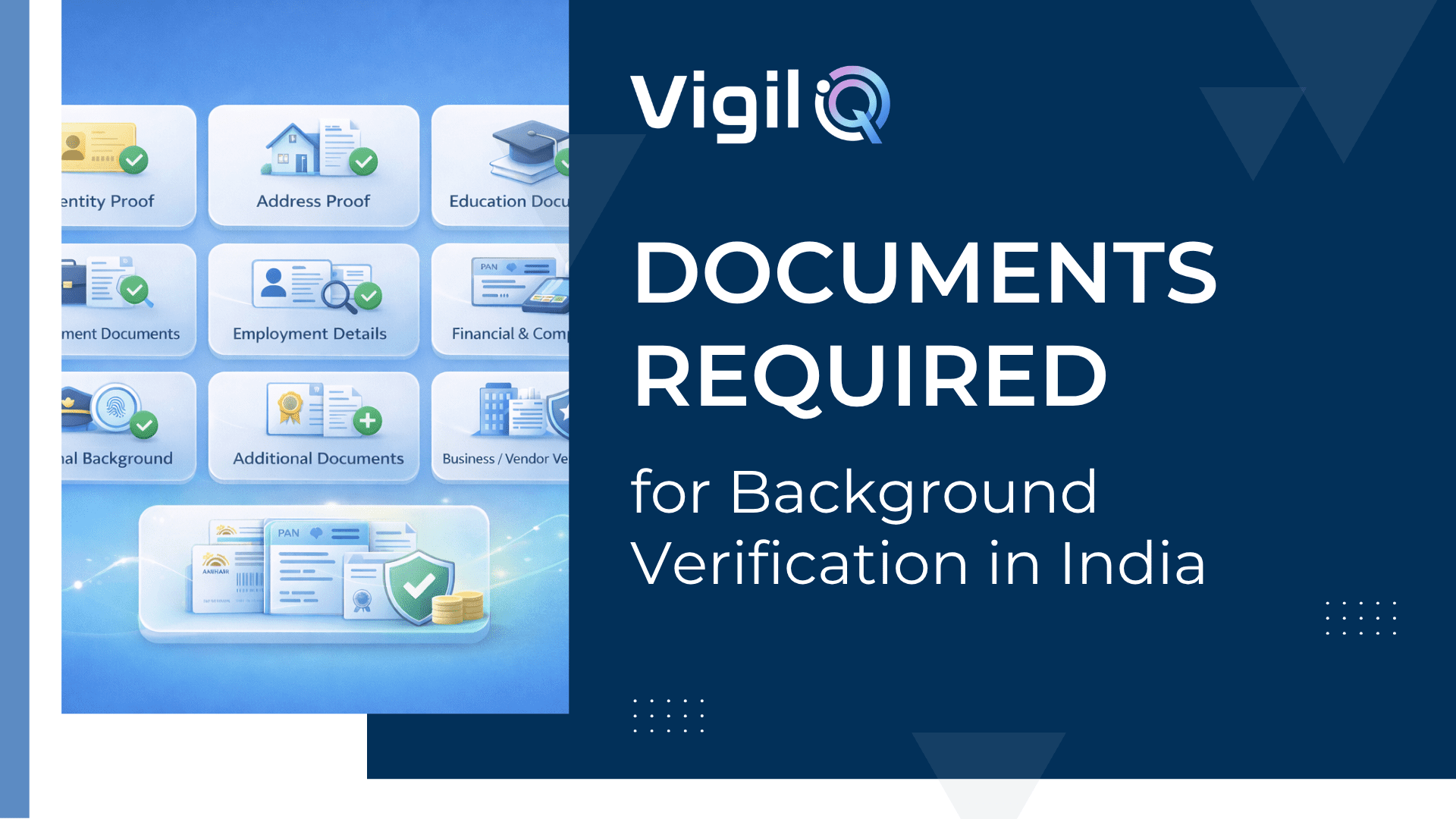
Documents Required for Background Verification in India
Background verification is an essential step in hiring. Companies must ensure that candidates provide accurate and genuine information. Therefore, understanding the documents required for background verification in India is important for both employers and job seekers. To understand how the full process works, you can read our detailed guide on background verification process in India.
Many candidates are unaware of what documents are needed. As a result, delays often occur during the verification process. However, when the correct documents are submitted, background verification becomes faster and more efficient.
Why Documents Are Important in Background Verification
Documents play a key role in verifying candidate information. Companies rely on official records to confirm identity, employment history, and address details.
Without proper documents, verification becomes difficult. Therefore, incomplete or incorrect documentation can delay hiring decisions. Moreover, accurate documents help companies reduce fraud and ensure compliance.
These documents play a key role in every step of the background verification process in India, ensuring accuracy and compliance.
Background Verification Documents in India
Different types of checks require different documents. Below are the most commonly required documents.
Identity Documents for Background Verification
Identity verification is the first step in background verification. It confirms that the candidate is genuine.
Common identity documents include:
- Aadhaar Card
- PAN Card
- Passport
- Voter ID
- Driving License
Companies often perform Identity Verification using these documents to validate candidate details.
Address Documents for Background Verification
Address verification ensures that the candidate’s residential details are correct.
Common address proof documents include:
- Aadhaar Card
- Utility Bills (electricity, water, gas)
- Bank Statement
- Rental Agreement
- Passport
Businesses perform Address Verification to confirm that candidates have provided accurate residential information.
Employment Documents for Background Verification
Employment verification is a critical part of the BGV process. It confirms the candidate’s work history.
Common employment documents include:
- Offer letters
- Experience letters
- Salary slips
- Relieving letters
- Employment certificates
Companies use Employment Verification to validate job roles, employment duration, and company details.
Educational Documents
Education verification ensures that candidates have the qualifications they claim.
Common documents include:
- Degree certificates
- Mark sheets
- Diploma certificates
- University transcripts
These documents help employers confirm academic credentials.
Criminal Record Documents
Companies may perform criminal background checks depending on the role.
Candidates may need to provide:
- Police verification certificate
- Court records (if applicable)
Organizations conduct Criminal Record Verification to ensure workplace safety.
Financial Documents (If Required)
For certain roles, financial verification is necessary.
Documents may include:
- Bank statements
- Credit reports
- Income proof
These checks are common in finance-related roles.
How to Submit Documents for Background Verification
Submitting documents correctly is important for a smooth process. Therefore, candidates should follow a few simple steps.
- Provide clear and valid copies
- Ensure documents are not expired
- Match details across all documents
- Submit documents on time
- Avoid fake or edited documents
Following these steps helps speed up verification and improves accuracy.
Common Mistakes to Avoid
Many candidates face delays due to simple mistakes. However, these issues can be avoided easily.
- Submitting incomplete documents
- Providing mismatched information
- Uploading unclear or blurred copies
- Using outdated documents
Therefore, always double-check your documents before submission.
How Companies Use Documents in Background Verification
Companies use documents to cross-check information with official records. As a result, they can validate candidate details effectively.
They may verify:
- Identity details using government databases
- Employment history through employers
- Address through physical or digital checks
In many cases, businesses use automated systems and APIs to verify documents instantly.
Role of Technology in Document Verification
Technology has improved how companies handle document verification. Today, businesses use automated tools to verify documents quickly.
For example:
- Identity verification APIs
- Document scanning tools
- AI-based verification systems
As a result, background verification has become faster and more accurate.
Benefits of Proper Documentation
Providing correct documents offers several advantages. Therefore, both employers and candidates benefit.
- Faster verification process
- Reduced hiring delays
- Improved accuracy
- Better candidate experience
- Stronger compliance
FAQs
What documents are required for background verification in India?
Common documents include identity proof, address proof, employment records, and educational certificates.
Is Aadhaar mandatory for background verification?
Aadhaar is commonly used but not always mandatory. Other ID proofs can also be accepted.
How long does background verification take?
It depends on the company and verification type. Proper documents can speed up the process.
Can background verification fail due to document issues?
Yes, incorrect or fake documents can lead to verification failure.
Do companies verify all documents?
Most companies verify key documents such as identity, employment, and address details.
Conclusion
Understanding the documents required for background verification in India is important for both employers and job seekers. Proper documentation helps ensure a smooth and accurate hiring process.
To better understand the complete workflow, refer to our guide on background verification process in India, which explains each step in detail.