Introduction
The way companies hire has evolved rapidly in recent years. However, one critical mistake many organisations still make is skipping or rushing background checks. The risks of hiring without background verification are no longer minor — they can directly impact business performance, security, and long-term growth.
In today’s competitive hiring environment, candidates can easily misrepresent information. As a result, relying only on resumes and interviews is no longer enough. This is why businesses are increasingly turning to structured background verification processes to ensure safe and reliable hiring.
Without proper checks, companies expose themselves to fraud, compliance issues, and operational inefficiencies. Therefore, understanding these risks is essential for any organisation that wants to build a trustworthy workforce.
👉 To understand how verification works in detail, read:
background verification process in India
Why the Risks of Hiring Without Background Verification Matter
Hiring is not just about filling positions — it is about making the right decisions. A wrong hire can cost significantly more than the time saved by skipping verification.
Today, hiring challenges include:
- Remote hiring and global talent pools
- Increased resume fraud
- Pressure to hire quickly
- Compliance requirements across industries
Because of these factors, background verification has become a critical step in the hiring lifecycle. Companies that invest in proper screening reduce risk, improve hiring quality, and build long-term trust.
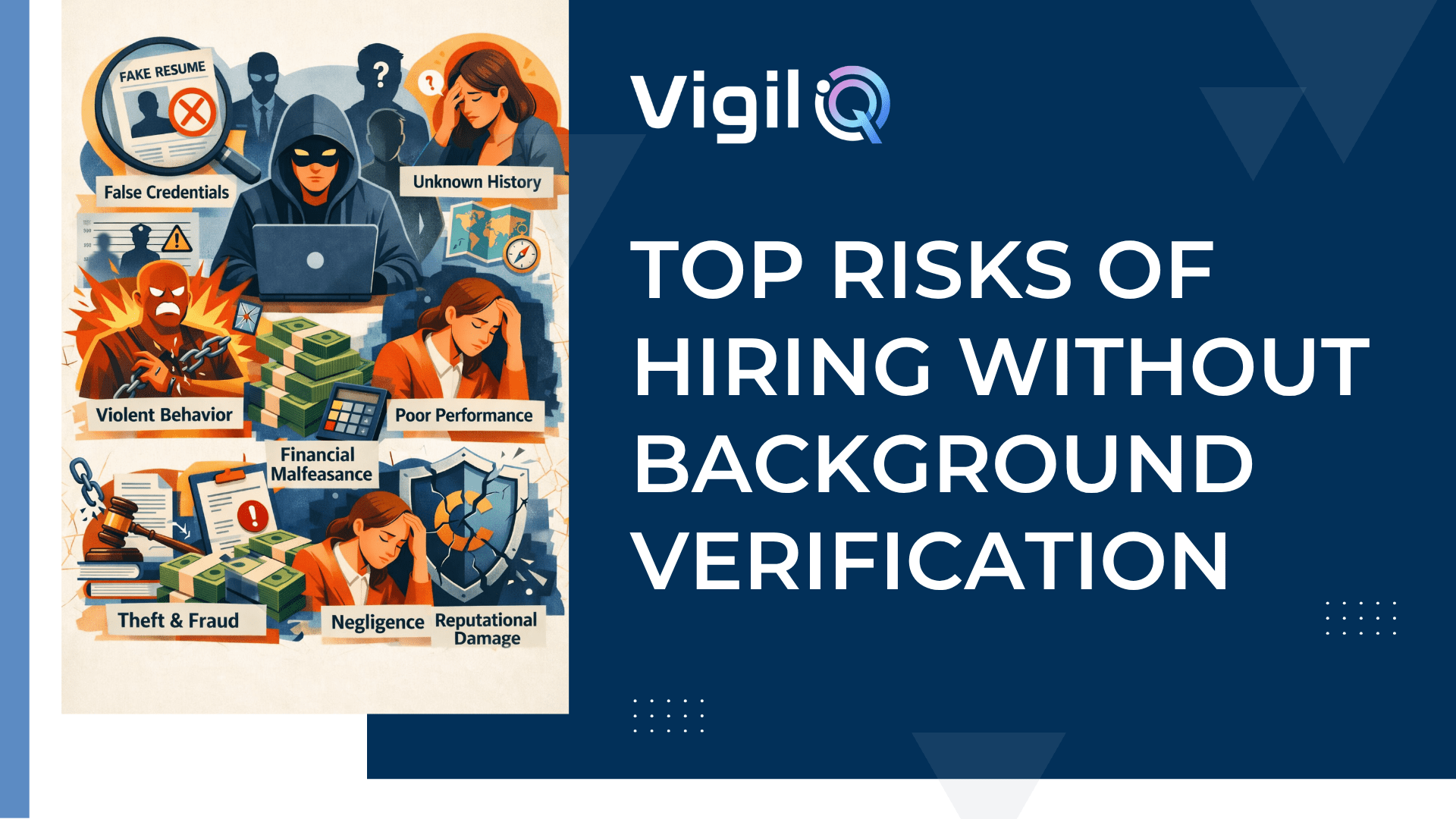
Top Risks of Hiring Without Background Verification
1. Increased Risk of Hiring Fraud
One of the most common risks is hiring candidates who provide false or misleading information.
Candidates may:
- Exaggerate work experience
- Provide fake employment records
- Use forged educational certificates
Without verification, these inaccuracies go unnoticed. As a result, organisations may hire individuals who lack the required skills or integrity.
This directly affects productivity and team efficiency.
2. Financial Losses and Hidden Costs
Hiring the wrong candidate is expensive — and not just in terms of salary.
Costs include:
- Recruitment and onboarding expenses
- Training and development costs
- Productivity loss
- Replacement hiring
Additionally, fraudulent employees may misuse company funds or resources. Therefore, the financial impact of skipping background verification can be substantial.
3. Legal and Compliance Risks
Many industries require strict employee verification.
For example:
- BFSI sector must follow KYC and compliance rules
- Healthcare requires credential validation
- IT companies must ensure data security
Failure to conduct proper checks can result in:
- Legal penalties
- Regulatory violations
- Contractual issues
👉 Learn more about compliance and hiring:
BGV companies in India
4. Damage to Company Reputation
Reputation is one of the most valuable assets for any business.
Hiring an unverified employee who engages in misconduct can:
- Damage brand image
- Reduce customer trust
- Impact partnerships
Even a single incident can have long-term consequences. Therefore, verification plays a key role in protecting brand credibility.
5. Workplace Safety Risks
Background verification helps identify potential risks related to criminal history or behavioural issues.
Without proper checks:
- Workplace safety may be compromised
- Employee trust may decline
- Organisational culture may suffer
This is especially critical in roles involving customer interaction, financial responsibility, or sensitive environments.
6. Poor Hiring Decisions
Without verified data, hiring decisions rely heavily on assumptions.
This leads to:
- Inaccurate candidate evaluation
- Poor performance outcomes
- Reduced team efficiency
As a result, businesses struggle to build high-performing teams.
7. Increased Employee Turnover
Wrong hires often fail to meet expectations or leave early.
This results in:
- High attrition rates
- Repeated hiring cycles
- Increased HR workload
Consequently, companies lose time, money, and productivity.
8. Data Security and Confidentiality Risks
In today’s digital world, employees often have access to sensitive data.
Without proper verification:
- Confidential data may be misused
- Systems may be compromised
- Cybersecurity risks increase
This is especially important for tech, fintech, and SaaS companies.
9. Loss of Client Trust
Clients expect companies to maintain high standards in hiring.
If an employee causes issues due to lack of verification:
- Client relationships may be affected
- Contracts may be lost
- Business opportunities may decline
Trust, once lost, is difficult to rebuild.
10. Operational Inefficiencies
Unverified hires often lead to inefficiencies across departments.
This includes:
- Poor collaboration
- Delays in project delivery
- Increased supervision requirements
As a result, overall business performance suffers.
How to Reduce the Risks of Hiring Without Background Verification
Background verification acts as a safety net for organisations.
It helps:
- Validate candidate information
- Detect discrepancies early
- Improve hiring accuracy
- Ensure compliance
- Build a secure workforce
👉 Explore solutions for modern hiring:
identity verification services
Manual vs Automated Verification: Why It Matters
Traditional verification methods are slow and prone to errors. However, modern API-based systems offer faster and more accurate results.
Benefits of automated verification:
- Real-time checks
- Reduced manual effort
- Better scalability
- Improved candidate experience
👉 Read more:
Manual vs API-Based Verification
Best Practices to Avoid Risks of Hiring Without Background Verification
To minimise risks, organisations should follow structured hiring practices:
- Always verify identity documents
- Conduct employment verification
- Perform criminal background checks
- Use digital verification tools
- Partner with reliable verification providers
A proactive approach ensures better hiring outcomes and reduces long-term risks.
Real-World Example (Scenario)
Imagine hiring a candidate for a finance role without proper verification.
Later, you discover:
- Their previous employment details were false
- They lack required experience
- They mishandle financial data
The result:
- Financial loss
- Team disruption
- Reputation damage
This scenario highlights why verification is not optional — it is essential.
Frequently Asked Questions (FAQs)
What are the risks of hiring without background verification?
The risks include hiring fraud, financial loss, legal issues, reputational damage, and poor hiring decisions.
Is background verification mandatory in India?
It is not mandatory for all industries, but it is required in regulated sectors and widely adopted as a best practice.
What checks are included in background verification?
Common checks include identity verification, employment history, address verification, education checks, and criminal screening.
How long does background verification take?
It can range from a few hours (for digital checks) to several days depending on the type of verification.
Can small businesses skip background verification?
No. Even small businesses face risks. Basic verification is highly recommended for all organisations.
What is the cost of background verification?
Costs vary depending on services and volume, but it is significantly lower than the cost of a bad hire.
Conclusion
The risks of hiring without background verification are too significant to ignore. While skipping checks may save time initially, it often leads to costly consequences in the long run.
From financial losses to reputational damage, the impact of a bad hire can affect every aspect of a business. On the other hand, a structured verification process ensures better hiring decisions, improved security, and long-term stability.
As hiring continues to evolve, organisations that prioritise verification will build stronger, safer, and more reliable teams.